ENGOCRACY a word for new meaning

Our brain houses a very complex, mostly subconscious model of how the world works. We use this model to make our largely intuitive decisions like what to eat, whom to trust, how to vote and what is right and what is wrong. We have a capacity to rationalize consciously, especially when it is a collaborative reasoning that filters out extreme divergences in thinking. Single mind reasoning is often hi-jacked by our emotions.

Words give us an entrance to our subconscious mental model. Each word carries a mountain of connotations based on our previous experience with the word. We can’t separate the meaning from all these connotations. Sometimes it’s best to coin a new word as a new anchor for different, maybe better connotations. Democracy is a good example. It has largely positive connotations as the answer to making a better world.

I believe that our faith in democracy is unjustified. It is unjustified on two counts, one there is no underlying rationale that what the majority want is in any way “right” or good. Maybe less people will be unhappy and the danger of an uprising is less when the majority agree. Second, the mechanics of democracy are so flaky and so easily hacked that policies produce by current democracies don’t come close to reflecting a true majority wish even under the guise of democracy.

We need a new word as an anchor for connotations of an engineered politics. We are an intelligent species, we can create good government policy as we have created such phenomenal engineering policy. I suggest a new word, “engocracy”, engineering power. This word has no connotations now so we can engineer its meaning.

People are very sensitive to whom they perceive having power over them. It is one of the prime social constructs that fuels our acceptance of any evolution of government. The main positive that democracy has is that it gives the false perceptions the we are masters of our fate. Engocracy will need to earn that perception as well but the link to engineering rather than politics will help.

There is a strong vote for accepting engineering values by the large number of people who fly around the world in engineered aircraft and aviation infrastructure, there are no signs of rebellion even if they didn’t vote for the people who made the decisions. When that aircraft takes off they are great-full it was designed by engineers, not politicians touting democratic control.

We need to make that radical switch in thinking that good decisions are seldom made by politicians, but engineers have a legacy of good technical decisions but also the social decisions needed for a robust aviation infrastructure.

Engineers designed a machine that can fly, a strictly technical problem that engineers are good at. But the engineering concept of evidence based decisions, cooperation, no ideology, conformance to standards and certified expertise produced the required infrastructure of the aviation world. Engineers also produced the atomic bomb, a technical problem but the control infrastructure was left to politicians.

We need a political Kitty Hawk so show that Engocracy can fly at 100 feet for 3 minutes to boot strap our route to the 747 of good politics.
Posted in Uncategorized | Leave a comment

Engineering methods

Cultivate expertise

Designing good government policy is much more difficult than designing the 747. But even the 747 was not designed by people with a desire for control and a persuasive personality. The engineering community seeks out expertise, apprentices it, certifies it and recognizes it.

The concept of experts recognizes that a domain is too complex for one mind to understand it all well enough to make good decisions. Experts limit their study and activity to a subset of the problem and then work together with other subset experts to construct a total view. The 747 had wing experts, engine experts, airframe experts and landing gear experts. The landing gear experts consulted with the wing, engine and airframe experts to determine the total weight their landing gear would have to deal with. One elected representative could not know enough about everything, so would make a “just wing it” (no pun intended) guess with possible dire consequences.

You could argue that if we elected one expert representative in each area, then the following debate could arrive at good decisions. Unfortunately our democratic system does not allow for diversity of expertise, in fact the party system tends to bias the legislature toward single mindedness. If there is diversity in the legislature, the debate is not about good cooperative decisions, it is about winning, about coercion, about spin and about winning the next election.

The other thing the concept of expertise does is compartmentalizes the problem into subsets that can be analyzed indepently. The landing gear design does not need to know about wing efficiency, it only need to know the weight of the wing and how much deceleration it can withstand. An education infrastructure system does not need to know about curriculum, it just need to know the number of education spots needed in each area of a district.

Once we are geared toward expertise, we can implement certification, trainings and apprenticeship, oversight bodies and a way to reuse and spread the expertise to other areas with out re-invention. Experts need to be certified, not elected. Experts use evidence,, past successes and objective analysis, not ideology to make policy decisions. Our party system is designed around ideology, not expertise. There is no ideology or democracy in designing a working aircraft. We need a working political/social system.

Democracy has one Hugh plus factor, voters have the perception that they have a say, some control over what governs them. That perception keeps them from demonstrating, rebelling, separating or outright staging a revolution. There is little truth to the perception but voting agents have a personality that is not entirely rational but that needs to be catered to in engineering a government.

Boeing can hire enough experts and assign them the task of building an aircraft and everyone is happy with the result. A country could not replace elected representatives with hired experts to make policy decisions. Autocrats do this by hijacking a weak democracy or using force and playing the role of expert themselves.

The engineered government will have to somehow make the governed people feel that it is fair, their interests are being looked after and no one is duping them. This will have to be real, not a figment of social media.

Posted in Uncategorized | Leave a comment

Engineered Government

This is a copernican idea. Democracy is not the centre of right government policy, engineering is the centre of our well being!

I am a naive, nerdy engineer who has a dream, a vision that we can engineer a better government than democracy has been able to deliver. With a population of over 7 billion, we need a government that makes policy and enforces it in a fair and moral way. Our own ingenuity must create this government, we the 7 billion agents must design how we will govern ourselves before democracy wipes us out.

We can’t wait for evolution to evolve a workable government. Democracy was a good mutation, but evolution can afford to let our species go extinct and let a new species with greater survival skill try their hand at government. We can’t afford that luxury. We need better government without waiting for evolution.

Complex things can only be created by evolution, because no one can predict how all the pieces of a complex system will interact together. We need to run it and observe. Biological evolution waits for random mutations and selects them by survival capability. Engineers have developed a faster evolution, evolution by design, where new mutations are designed, albeit imperfect design, and tested by functionality. The 747 aircraft evolved in 70 years. Many mutations of aircraft crashed and burned in the process because our design is imperfect but it is much faster than random mutations Many subspecies of aircraft were created that are still evolving.

Let’s apply the engineering model to government design. First we need to know what is “good”. Our democracy bias would say that which the majority support is good. There must be an intrinsic measure of good that could be the survival function for good policy design.

There is an elusive concept called the “grater good” which will be the survival function for good policy. It is an extension of what would make us as individuals feel good extended to everyone around us. It is selfishness for our own good feelings merged with empathy for the feelings of others. Democracy addresses the selfish aspect and merges it with our well developed use of tools and methods we have learned to control and manipulate. The great divide in our partisan debate about right vs left is largely about the role of empathy in our polices.

The first step in engineering good government is to research and develop the concept of the greater good. We must have greater good departments at all university’s, establish research chairs in greater good and make research grants available. It is a switch from the good of an individual to the good of a group. We have learned this for family group but need to expand this to communities, nations and the world.

Engineering is science based on evidence and good exhaustive rationalizing. Truth comes from good measurement and good logic. The greater good is a very complex concept especially for a species like ours with so much self interest bias. The survival function for our own species needs to be the greater good.

Once we can define a greater good survival function we can apply all the well understood engineering methods like specialization, reuse, compartmentalizing and redundancy. Future posts will explore these topics

Posted in Uncategorized | Leave a comment

Democracy will be the end of us

We have this fantasy that if every country in the world was a democracy, we would have a workable world. Democracy cannot make good government policy. Was Brexit good policy, did the Tump administration make good policy, is Netanyahu making good policy? We nor our democratically elected reps know what good policy is or have any hope of implementing good policy.

Let’s take a critical look at democracy. Where did the idea that the majority is “right” in any sense of the word come from? We can theorize that if the majority gets what they want, then the most people will be happy but happy is not synonymous with right. Right must be engineered and we can take a lot of pages from the engineering book to create “right” policy as will be explored in this blog.

More about democracy, it is very hackable. Individuals, groups and even AI like Cambridge Analytica can hack it. Control is not in the hands of the majority. Control is elusive, it shifts as power players try different tactics. We don’t know what impact Russian meddling had on the US election, only that there is not a clear majority control.

Democracy had a hey day when it replaced the concept of kingship and birth right. Elected representative were from the educated and economic nobility. Their status allowed them to show some altruism and implement some right policies. This hey day started the dream that democracy was “right”. Today it has become a path to power, not “right”. The concept of wisely chosen people engaged in an objective debate to determine a best policy is captivating. Political debate however is mostly about changing minds to support partisan views, not about best.

Democracy has a lot of mechanics. Proportional representation, first past the post, referendums, suffrage which all affect the winner outcome but not the “right” outcome. The mechanics should be a proven thing by now, not a “Hail Mary” thing.

Lobbyists have more control than the electorate. Governments like Russia’s are only pretend democracies, the voters have no control.

The need and desire of a representative to be re-elected creates an automatic conflict of interest for any policy decisions that need to be made. In engineering, decisions are made by certified experts who don’t need to make decisions to retain influence.

One vote every 4 years is not control. We vote according to ideology. Ideology can guide our reasoning about policy but should never be the final straw. We may feel strong about free trade, but a policy that starves a large number of people can’t be right. Ideology can be a direction guidepost but never a decision maker.

Referendums don’t work. The voting agents don’t take the time or have the motivation or the facts to understand and rationalize about an issue before they vote. Brexit was mostly about one issue, immigration and all the other factors needed a lot more expertise to analyze. We have the technology to implement a true democracy, every evening the issues are presented on TV and everyone votes with a special button. This would be real control but would be a disaster.

Engineering has made some very good decisons in the past. In 1905 the Wright brothers had an idea about how to make a machine that flies. By 1970 it hade evolved to a Boing 747 aircraft that could take hundreds of people around the world in a very safe, multi country infrastructure of airports, navigation aids and safety standards all done by experts, non by democracy.

In contrast, democracy first appeared about 4000 BC in Greece but today in 2024 it has a very dismal record. My next post will be about looking at government from an engineering point of view. Can we create a government 747 by being smart?

It’s only a matter of time before the bad policy coming from the hodge-podge of current democracy results in a catastrophe such as a nuclear war. My next blog will look at how we might engineer good policy using an engineering approach. We can’t fix democracy, we must replace it.

Posted in Uncategorized | Leave a comment

New Direction

How to govern ourselves is the most existential problem that mankind faces today. We may eventually all die because of global warming but the bad governing policy decisions being made by the world power structure every day is killing and causing suffering for more people at a much grater rate than global warming or any other cause.

As a population, we are smart, innovative and phenomenal problem solvers in the science and engineering world. Not so in the political and cultural domain where things seem to get worse and worse.

My first assumption looking st this problem was that we needed a blueprint like language whose meaning was clear and precise if we were to solve our political problems. Further reflection however showed that it wasn’t a language problem but that we needed a complete redesign of the concept of how a population of over 7 billion people can effectively govern themselves for the good of all people.

Some of the key things I will discuss are the need for a new science of “the greater good”, how the concept of democracy may be our eventual downfall because democracy doesn’t work, can’t work but we have no other tools in our toolkit. I believe there is a “truth” in collective logic and rational that we can use to make better policy decisions than democratic popularity.

These are my ideas and the ideas of one person have very little value but if these ideas are reinforced by many other minds conferring, evolving and giving them legitimacy, they can begin to make a change.

My ideas are strongly based on engineering metaphors, not surprising since my former life was as an engineer. In engineering, decisions are made by experts who become experts by training, experience and mentorship.

Stay tuned. My next post will be about how democracy could doom us.

Posted in Uncategorized | Leave a comment

Words are not enough for political debate

The language of words that humans have evolved over the last 50 thousand years or so, have helped make us the dominant species on earth but have also become the biggest millstone around our necks. Rudyard Kipling said “Words are of course, the most powerful drug used by mankind”. Words are great for poetry because their meaning is mostly suggestive and the listener fills in the gaps. Our minds which have evolved over millions of years through our animal ancestors, are an “instant answer” mind that gives us a subconscious instant answer to any situation. These are good instant answers because they have kept us alive and reproducing for millions of years. Words are a very recent addition, in evolutionary time, to our mind and we waste a lot of time translating our subconscious to and from words which have a very vague and questionable meaning. Our minds are not word based, but we need words to be conscious of our thoughts and to share them with others.

Technology has exasperated the situation. We assumed that when technology gave us the capability to speak to anyone, any time, any where, our ability to collaborate effectively would increase dramatically, it actually hampered collaboration. First, it drowns us in words, and second, we have learned to use words more like a drug to coerce, mislead and confuse in a political context, and technology makes that happen faster, has a further reach and provides anonymity to the speaker. 
The engineering community has long abandoned words in favour of a blueprint language. Imagine building a skyscraper that would not fall down, with narrative text. Yet we build our very complex political structures using only words. Words simply inflame the rhetoric, the partisanship with the vagueness and absence of a definitive meaning. This blueprint language may be part of the reason that engineering progress in the last 100 years has been astronomical but political progress has been marginal at best.
 

When we evolved our language, the only technology we had was a larynx that could make a large variety of sounds and a brain that could distinguish and associate meaning with different sounds. It is interesting to note that many animals have this same capability but none have evolved an elaborate language like we have. One theory is that words make lying too easy so animals stuck to body language and smells which makes deceit more difficult.
We need to evolve a new language that has the precision and accuracy of an engineering blueprint to collaborate about political matters. This will not of course look anything like an engineering blueprint but will give us the same benefits that blueprints have given the engineering community. We now have the technology to do this, a very powerful computer in everyone’s pocket called a smartphone. Phonetic symbols of course, won’t work.
Evolving a blueprint language for political and social debate will not be easy. There is an urgency however, the world political situation is rapidly taking us into some very dark corners and we must ensure that the futurists who say that computers will soon understand words like we do, are wrong. Imagine billions of computers using language like we do to persuade, control, deceive and evade meaning. This evolution must begin immediately if we are to avoid the negative consequences of our very faulty language.
A picture is worth a thousand words. Blueprints are pictures and pictures have so many advantages over the long sequential string of words we use today. A blueprint begins with a metaphorical floor plan, an overview of the whole layout of the discussion space. It shows how major components are related in space and size. The reader decides what to focus on and she can drill down to more and more detail. In a word narrative, the speaker decides what to present first and next and often what to omit. This gives the speaker much too much power and creates an ideal partisan framework.
A blueprint is not an off the cuff spontaneous statement like words tend to be. Blueprints are developed by many experts collaborating over an extended period, all details are supplied and nothing is left for the reader to infer. The blueprint is in fact the basis of collaboration and agreement. Words are like trying to construct a picture by looking at it with a pin hole lens but the speakers decides which part of the picture to focus on. It is always incomplete and biased by the speaker.
What might this social blueprint language look like? We don’t know yet, it must evolve over time? Evolution always provides an answer. Evolution means trying, rejecting, improving and spreading successes. Let’s assume that our subconscious mind works with things we will call “conceptual objects”. We don’t know what these are yet but they are snippets of of our mental model of how the world works. Animals who have no words would use these for thinking and deciding, as would pre language children. If we could identify what these conceptual objects are that we need to function and collaborate and then develop a way to represent them in a visual way on our smartphones, we would have the basis of a blueprint language. Academics have long suggested a visual language but they always begin with a formalism, a set of rules which implies we can design such a language. Nothing complex can be designed, it must evolve.
The basis for any political issue should be the metaphorical “floor plan” which shows the major components involved. This floor plan is the conceptual map of the discussion. The reader can choose which component to “drill down” for more detail but they will be aware of what else is involved. Imagine if all Brexit voters had a good conceptual map of all the issues that Brexit impacted, not just immigration. The outcome may have been much different.
A real floor plan is a two dimensional area that shows each room, how big it is, and how it connects to the other rooms. In our blueprint of abstract ideas, it could be one, two or many dimensions but it would still show the major components, how big they are and how they connect. It would have to be developed by many experts across partisan boundaries collaborating to produce an inclusive conceptual map showing all partisan positions. The key is to show the complete picture, not the bias that political speeches focus on.
Since political discussions are about how we should govern ourselves, the concept of “common good” is very key. Common good looks at how the benefits and pain of any political decision are spread across the population. The European Union reduces each country’s control of immigration but reduces the conflict of many factions competing and struggling for power brought on by balkanization and splitting jurisdictions. Everyone is partisan and their subconscious attaches a currency to the benefits and costs for comparison. A blueprint language could show the relative costs required for each position.

To bootstrap this evolutionary process, we need to look at what these subconscious conceptual objects might be. It is not surprising that many of the words we use have an underlying conceptual object. For example “fairness”. We all know what it means but a lot more needs to be said to make it have meaning in any particular use. It’s like having to fill out a 3 page form of the details in a given usage. A blueprint language could have a standard list of details that needed to be supplied for every usage of the concept.
Our own conceptual objects probably underly our partisan beliefs. Union and cooperation reduces conflict and infighting but it also reduces control of internal matters. Our own partisanship shows which we rank as more important.
Many abstract concepts are based on physical metaphors. Higher is better so when ranking options, the higher ones are better. This can be easily shown in a diagram.
Here are some more possible conceptual objects to start the process. They might survive, they may mutate and morph or they may die.
A fact – we want our decisions to be rational and evidence based. A fact has a lot of details, like a form that must be filled in if we want to use it. Things like the source, how accurate is it, what time period is it valid, evidence of authenticity, accuracy, etc. Politicians abuse facts routinely which often completely negates their statement. Facts might be shown visually in relation to other facts that might be relevant.
A scale – we need to order the things in our world, what ranks higher, how much different is it and what are the extremes. Scales are naturally represented visually.
Fairness – fairness is a very important concept in social thinking. To define it, we need to specify the currency of comparison, the stakeholder, the position of each stakeholder on the scale of the currency and the positions that one could take.
There are many ways to uncover our subconscious conceptual objects. We could study how children think and react before they know words. We could study how people paraphrase words they have read. We could observe animal behaviour and we could just throw ideas out there and see if they work.
How to make this happen
To make this happen we need a large player like Apple, Google, Microsoft or Facebook to give it legitimacy and provide a variety of free tools for people to begin experimenting. Our young generation which already does much of their communication through the smartphone will probably be the leaders in this effort. Politicians will resist and the older generation will probably be noncommittal but receptive because they would like to leave the world in a better place for their grandkids.

Posted in Uncategorized | Leave a comment

Articulating mechanical legs

Biolosgical evolution has given us words and the physiology to speak, hear and understand them. Biology always has limitations so we rely on our technology if we want to go faster, further or higher than biology allows. Our articulated legs, though very versatile, limited how fast and far we could go. When we applied technology, we didn’t emulate our legs with mechanical legs, we took a step back and used the wheel and smooth surfaces to allow us to go much faster and further than mechanical legs ever could.

We now have the technology in our pocket smartphone to share more words further and quicker and hopefully get more meaning from those words to solve our social problems. The result however is that we are drowning in words but have no better understanding of what those words mean. This is because we use the technology to emulate words but the real limitation is in the words themselves, like the limitations of articulating mechanical legs. We need to step back and focus on the objective of words which is to share meaning and insight.

To achieve this we can take a page out of the engineers handbook. They have long replaced words with a visual blueprint language using the computer as a medium. Our mind does not work in words, they are a very recent addition to a mind that has evolved over millions of years. Our mind deals with what I will call Conceptual Objects. These are mostly subconscious, might be visual and are how we deal with a very complex words in our mind. We need to uncover what these conceptual objects are, find a way to represent them in our smartphones and give us tools to create, manipulate and share them.

This BPS language might be the route to harnessing our technology to give us that boost in effective collaboration that we so desperately need. Emulating words only drowns us in more ineffective words and sometimes even works at cross purposes with collaboration

Posted in Uncategorized | Leave a comment

The Meaning Gap

Words do not have an unambiguous meaning. The meaning of a group of words is in the mind of the speaker and the mind of the listener. Each are coming from a different context and different experiences with those words. This leaves an interpretation gap. This gap may be insignificant when speaking about factual things or when speaker and listener have similar experience, beliefs or culture. However the gap may be significant enough to make the communication meaningless or even harmful if the parties are very different, antagonistic or partisan. This is why words are so unsuitable and even harmful for political discourse.

As an example, take a word like “unfairness”, an important concept in political discussions. The word, like most words is very generic. The word can be used in many situations of unfairness. The mind could not cope with a different variation of the word for all the situations it could apply to. Instead we add more words to make it specific but each of these words has their own meaning gap, thereby compounding the meaning gap.

We now have an important addition to our brain, the smartphone we all carry in our pocket. We can use this to represent our thoughts in a more meaningful way than words and then communicate those thoughts without the meaning gap to everyone else.This new language which I call BPS (BluePrint Speak) does not exist today. It will have to evolve with many people using it in a trial and error process until until we have something suitable for political debate.

It is blueprint like because on the smartphone we can make it visual which we can’t do with words. We can also make it unambiguous by adding enough detail layers so the listener can drill down and not have to make their own assumptions about what was meant.

To imagine how this might work so we could get started, if we used the word “unfairness” in a text, we could click on it to open up a large form to be filled out to provide all the needed details. An analysis of the concept would show the key components and attributes that are needed.


The meaning gap presents a big problem for our expectations that our smartphones will soon understand our words. What context and experience will the computer use to fix the meaning of the words it receive? A BPS language would put the responsibility for detail on the speaker, not the listener. We would have a common language that both we and our smartphone could understand.

Posted in Uncategorized | Leave a comment

Conceptual Map example

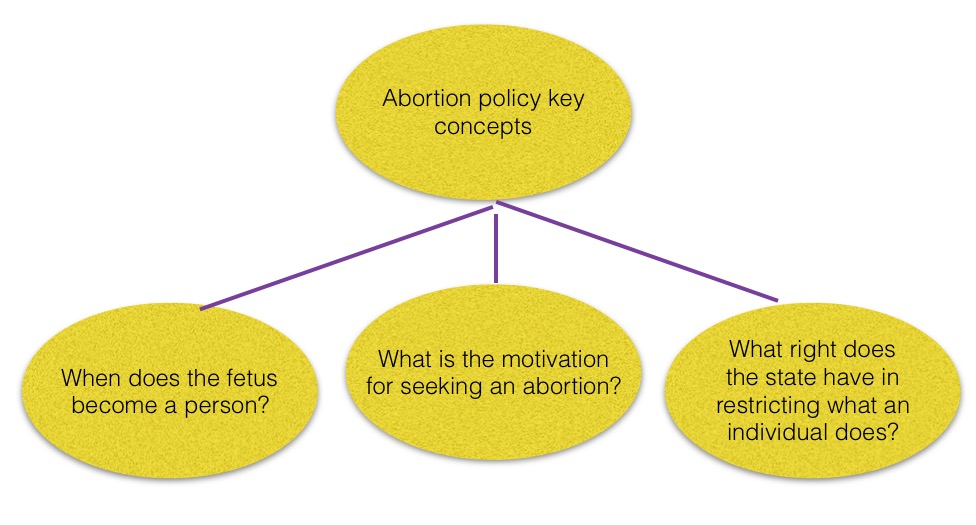
The following is what a conceptual map might look like for a debate on abortion. This represents the view of one person, in practise it would represent the collaboration of many from all sides of the abortion debate.

It should start with a “floor plan” which shows the whole layout. The user can select any of the elements to reveal the underlying details.

image

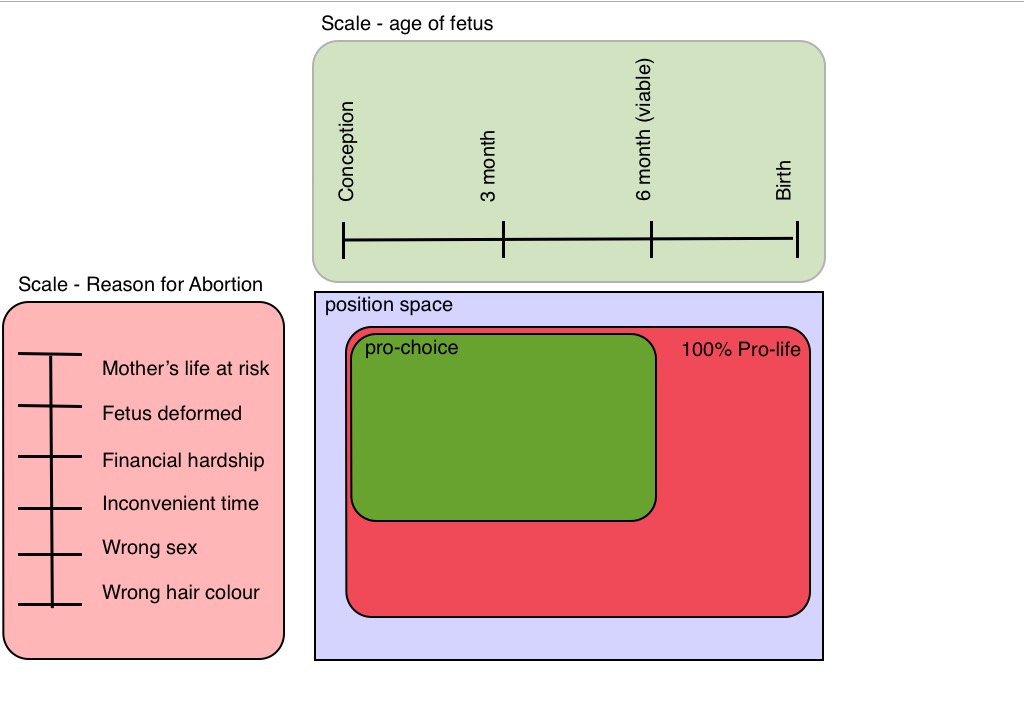
The lower nodes would reveal a scale to represent the range of possibilities for fetus age, motivation for abortion and state control rights. If we map age of the fetus against the motivation for an abortion, we can map the space occupied by the various camps in the debate.

image


More detailed positions could. Be mapped.

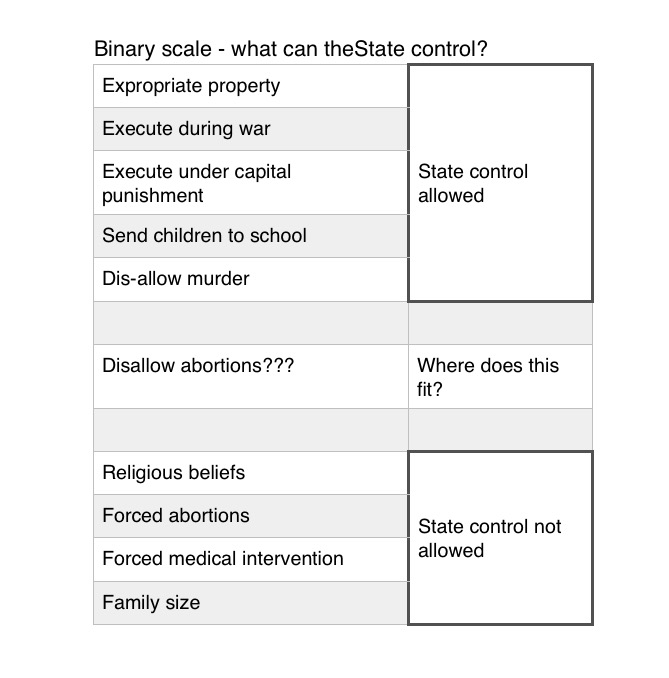
The last scale is a binary scale of examples of generally accepted things the State has a right to control and generally accepted things the State has no right to control. Abortion sits in the middle for debate on where it should fall.

image


Posted in Uncategorized | Leave a comment